



Heat-Affected Zone (HAZ) in Welding of Railway Structures- How to Ensure Durability and Precision?
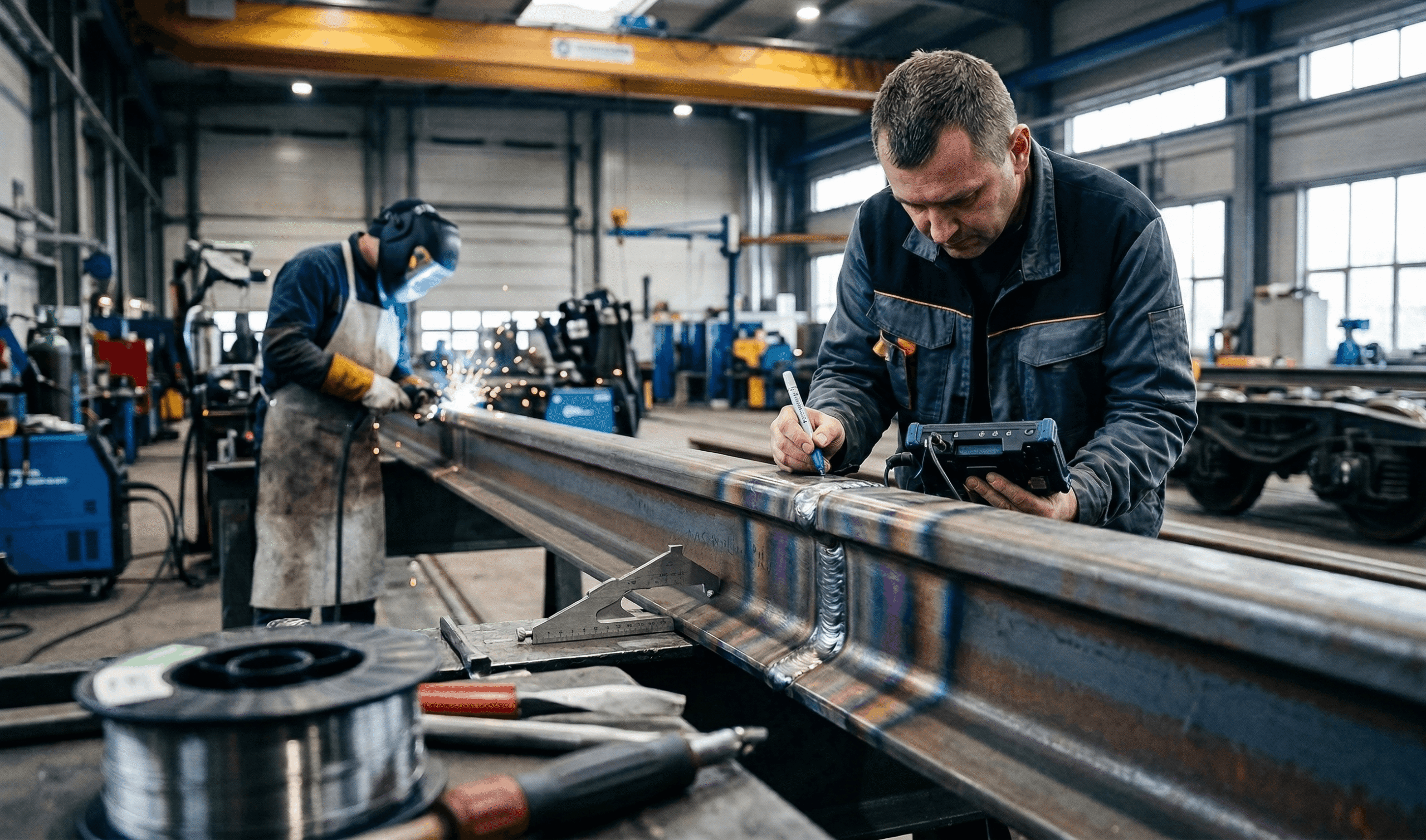
In the railway component production process, the Heat-Affected Zone (HAZ) is an area of the parent material that did not melt, but changed its physical properties and microscopic structure under the influence of welding temperature. Improper management of this zone leads to cracks, corrosion and loss of dimensions during subsequent machining.
Key Facts About HAZ in the Railway Industry:
- Structural changes: High temperature can create hard and brittle martensite, which is susceptible to cracking under dynamic load.
- Structural integrity: Railway elements operate under conditions of continuous vibrations; weakened HAZ is the most common site of fatigue failure.
- Precision of execution: Internal stresses in HAZ cause “material memory”, which without proper annealing results in part deformation during milling.
- Solution: The synergy of controlled welding, heat treatment (stress relief) and precise CNC machining.
Table of Contents:
- What Is the Heat-Affected Zone (HAZ), Exactly?
- Science in Service of Railways – Phase Transformations in Steel
- Why Does the Railway Industry Not Forgive HAZ Errors?
- Material Memory – the Hidden Enemy of Precise Milling
- How Does EDBA Minimize the Negative Effects of HAZ?
- Heat Treatment After Welding: Annealing as the Foundation of Quality
- FAQ – The FAQ – Most Common Questions About HAZ and Safety
What Is the Heat-Affected Zone (HAZ), Exactly?
Imagine you’re baking a cake, but the bottom is burnt, the middle is perfect, and the top is raw. It can be a similar case with steel during welding. Although we’re joining two elements, the material located right next to the weld undergoes “thermal shock”.
The Heat-Affected Zone is a band of material that was hot enough to change its atomic arrangement, but not hot enough to become liquid. This is precisely where failures most often occur. In the railway industry, where wagon bogies or rail elements carry tons of pressure, this zone can “make or break” the entire project.
Science in Service of Railways – Phase Transformations in Steel
Steel is not a uniform block of matter – it’s a complex crystalline structure. Under the influence of welding heat (often exceeding 1000°C near the arc), so-called phase transformations occur.
The greatest threat is the formation of martensite. This is a very hard structure, but at the same time: brittle as glass. If too much martensite forms in the HAZ, rather than “work” slightly under the weight of the train, the railway element will simply crack. According to technical reports on rail failures, up to 70% of fatigue cracks originate precisely from an improperly formed heat-affected zone.
Why Does the Railway Industry Not Forgive HAZ Errors?
Safety is an absolute priority in the railway sector. Elements such as bogie frames, kingpins or brake brackets must withstand millions of load cycles.
- Stress corrosion: The altered chemical structure in HAZ causes steel to rust faster in this specific location.
- Wytrzymałość zmęczeniowa: Even a microscopic scratch in HAZ can turn into massive crack within months due to train vibrations.
This is why at EDBA we know that professional machining must go hand in hand with deep understanding of welding metallurgy.
Material Memory – the Hidden Enemy of Precise Milling
Have you ever straightened a paper clip, only for it to “want” to return to its previous shape after a moment? This is a simplified example of material memory.
When we weld a large railway component, enormous stresses form inside the steel. If we immediately proceed to the stage of CNC milling, after removing the element from the machine it may “spring back” by a few millimeters. For a precision engineer, this is a catastrophe – dimensional tolerances are exceeded and the part becomes scrap.
How Does EDBA Minimize the Negative Effects of HAZ?
At EDBA, we approach the welding process systematically, combining modern technology with artisan precision:
- Linear energy control: Our welders precisely dose heat. The less heat we introduce into the material, the narrower the Heat-Affected Zone will be.
- Appropriate cooling: We don’t allow the steel to cool too rapidly or too slowly, which prevents the formation of the previously mentioned brittle martensite.
- Edge preparation: We use advanced turning for perfect preparation of sheet beveling, which allows for laying fewer weld beads.
Heat Treatment After Welding: Annealing as the Foundation of Quality
To eliminate “material memory” and neutralize the negative effects of HAZ, we use stress relief annealing. This process involves heating the finished weld to a temperature of approximately 580-650°C, holding it, and then very slow cooling.
What does this get the client?
- Dimensional stability: After annealing, subsequent CNC grinding proceeds without surprises. The material doesn’t “work” during machining.
- Longer lifespan: Removal of internal stresses makes the part significantly more resistant to cracking.
Thanks to this combination – from welding, through heat treatment, to final milling – we deliver components that meet the most rigorous safety norms in railway engineering.
FAQ – The Most Common Questions About HAZ and Safety
1. Does every weld need to be annealed?
Not always, but it’s the standard in the case of key structural elements in the railway or maritime industries. Everything depends on material thickness and design requirements.
2. Can HAZ be completely eliminated?
No, every thermal welding creates a heat-affected zone. However, we can control its width and properties through appropriate welding parameters.
3. How to recognize HAZ problems without specialized equipment?
It’s almost impossible with a naked eye. The problems reveal themselves only during machining (deformations) or during operation (cracks). This is why choosing a contractor with appropriate certification and research facilities is so important.
4. Is machining after welding necessary?
Weld precision rarely suffices in the railway industry. To obtain surfaces of high accuracy for bearings or mountings, CNC milling after welding is essential.
Looking for a Partner Who Understands Metallurgy and Will Deliver Parts Ready for the Toughest Tasks?
Contact us and we’ll help you go through the entire process – from choosing the welding technology, through heat treatment, to final surface finishing.