



Reliability in extreme conditions – how quality control creates safety in energy technology

A game for the highest of stakes
Imagine the forces at play within the heart of the energy sector – the crushing pressure inside a pipeline at the bottom of the sea, the cryogenic cold of liquefied natural gas inside a -150°C tank, or the heat inside a power plant boiler that reaches 1600°C. In this kind of environment, component failure is not a simple setback; it’s a potential catastrophe. A single, microscopic flaw, an imperceptible deviation in the fit can kick start a chain reaction leading to blackouts, environmental damage and massive financial losses.
This article deconstructs the complex, layered quality control strategy which is a foundation of absolute reliability of critical components made for the energy sector. We will demonstrate that true reliability is not something added at the inspection stage, but a fundamental, designed result of a meticulously planned and rigorously executed quality assurance process – from raw material to final assembly.
The battlefield – why does the energy sector not forgive mistakes?
Understanding why such rigorous quality control is indisputable requires a deep analysis of the operating environment in which energetic components must function.
Exploring a hostile operating environment
The dangers that machine parts face are not a series of independent challenges, but a synergistic matrix of simultaneous, mutually empowering forces. High temperature accelerates corrosion, while high pressure thrusts aggressive media into the microscopic flaws on the surface, increasing the stress corrosion cracking. The component must be designed and verified not only accounting for resistance to heat or pressure, but also its ability to endure an all-out attack on its structural integrity.
- Extreme temperatures – the spectrum is wide – from cryogenic conditions (-160℃) necessary to store liquefied gases such as LNG and liquid hydrogen (-253℃) to sweltering heat during the energy production process
Additionally, the temperature of fumes in the combustion chambers of modern gas turbines exceed 1200℃. In critical points (such as the leading edge of the first blades section), where the hot gas stream flows locally, these values can reach at points even 1500℃ – conditions which without advanced thermal barrier coatings (TBC) and internal cooling would immediately lead to the material’s destruction.
- High pressure – it is a consistent element in traditional coal, gas and oil-powered plants, as well as the oil and gas industry. It exerts extreme mechanical stress on every part – from pipes, through valves, to sealing and turbine blades.
- Aggressive corrosive environments – components are in danger of chemical attack from corrosives substances, abrasive particles or demanding media, such as hydrogen (H2) and carbon dioxide (CO2). This leads to pitting, stress corrosion cracking and erosion, threatening the durability and security of the entire system.
Cascading consequences of malfunction
The true cost of one component’s malfunction is not linear, but exponential. The direct cost of replacing a damaged part is minuscule in comparison to the cascading secondary and tertiary costs, which include system downtime, incidental damage, regulatory fines and a ruined reputation. The malfunction of cheap sealing can stop an entire power plant in its tracks, kick starting an avalanche of financial and operational losses. This creates an indisputable business argument: investing in a perfectly produced and rigorously audited component is a logical and indispensable risk mitigation strategy.
- Economic consequences – a malfunction can lead to a blackout, and every hour of downtime costs the economy millions of euros. This also leads to immediate production stoppage, loss of critical data or the destruction of materials vulnerable to processing time or temperature.
- Infrastructural damage and safety – apart from financial losses, malfunctions threaten damage to critical infrastructure such as transformers and destabilizing the entire power grid. Case studies show that material or design flaws are often the main cause of catastrophic malfunctions in power plants, which underscores the direct relation between component quality and public safety.
The foundation of reliability – materials selection and precise CNC processing
The first line of defense against failure is utilizing advanced material that can handle extreme challenges.
Advanced materials for extreme environments
- Nickel-based superalloys – materials such as Inconel, nickel-chrome superalloys, are valued for their incredible durability and resistance to corrosion and oxidation in extreme temperatures. This makes them necessary for the production of turbine, combustion chamber and hydrogen installation components.
- High-performance steel – a wide range of steel is used in energy, including structural steel (e.g. S355), steel for pressure equipment and specialist stainless steel. In nuclear energy, austenitic grades such as SS316 are key, due to their resistance to corrosion, as well as precipitation hardened steel (PH), which achieve enormous durability after heat processing.
- Machining challenges – the same traits that make these materials durable make them incredibly hard to process. Superalloys such as Inconel cause rapid tool wear and tear, requiring the use of specialized cutting materials (cemented carbides, cBN, ceramics), low processing speeds and advanced strategies, which vastly increases production complexity and cost.
CNC machining – precision technology
Computer numerical control machining technology (CNC) is key to processing these advanced materials into functional components of the highest quality.
- Process overview – basic CNC machining such as CNC milling, CNC turning, grinding and cutting allow the production of parts with complicated geometries with a precision otherwise unattainable through conventional methods.
- Precision and repeatability – CNC technology allows to reach very tight dimensional tolerances of around ± 0,01 mm or better, while guaranteeing excellent repeatability in serial production. It is a necessary condition for producing interchangeable and reliable parts.
Energy Sector Materials Comparison
The table below is a practical tally which helps with making conscious decisions regarding material selection depending on application.
| Material | Key Properties | Typical Applications in Energetics | CNC Machining Challenges |
| Duplex/Superduplex steel (e.g. UNS S32750) | Incredibly high mechanical durability and almost double the resistance to pitting and pressure corrosion in comparison to standard stainless steel. | Underwater and offshore pipeline elements (Oil & Gas), heat exchangers, valves for aggressive environments (e.g. containing hydrogen sulphide). | Harder machinability than 316L, requires high machine stability and tooling stiffness as well as precision cooling. |
| Inconel 718 | Incredible durability in high temperatures of 700°C, corrosion and oxidation resistance. | Gas turbine blades, combustion chamber elements, nuclear reactor components.. | Extremely hard machinability, very high tool wear and tear, requires low cutting speeds. |
| Stainless Steel 316/316L | Excellent corrosion resistance (especially pitting), good mouldability. | Pipelines, heat exchangers, elements operating in chemical and sea environments. | Limited machinability, tendency to harden during machining. |
| Precipitation Hardened Steel (17-4 PH) | Very high endurance and hardness after thermal machining, good resistance to corrosion. | Shafts, connectors, valve parts, nuclear energy components. | Requires machining when annealed and precision thermal machining afterwards. |
| Structural steel (e.g. S355) | Good weldability, high resistance to stretching, cost-effective. | Construction elements, structural frames, supporting frames, machine casing. | Good machinability, standard cutting parameters. |
The anatomy of quality control – a process, not a one-time inspection
Quality is not the result of a one-time inspection at the end of the production line. It’s a constant, multi-stage process which ensures compatibility at every step.
Multi-stage quality control framework
- IQC – Incoming quality control – the first line of defense. Focuses on verifying if the raw materials are compliant with certification and specification. This prevents the introduction of flawed material into the production process.
- IPQC – In-process quality control – constant monitoring and measuring during the production process. This allows to detect deviations early and prevents producing entire batches of flawed parts.
- FQC – final quality control – the final, complex inspection of a finished component. This is the ultimate verification whether all specifications – dimensions, geometry and surface finishing – have been met before shipping.
The heart of a metrology laboratory – coordinate measuring machines (CMM)
- Functionality – CMM machines are advanced devices that utilize a probe to measure an objects geometry in 3D space with the accuracy reaching micrometers (1 micrometer = 0,001 mm).
- Key role – their goal is validating the physical part in relation to its digital project (CAD model), ensuring that the complicated geometries and tight tolerances are perfectly reproduced. They generate detailed, identifiable reports which constitute objective proof of quality.
Precision’s invisible enemy – the measurement environment
The accuracy of the finished product cannot exceed the accuracy of the measuring system used to verify it. Meanwhile, the accuracy of the measuring system is fundamentally limited by the stability of its physical environment. This creates a „chain of precision”, in which an error in environmental control (e.g. a 2°C temperature fluctuation) can entirely invalidate the entire quality control process, potentially leading to the shipment of an incompatible and dangerous part.
- Thermal expansion – all materials expand due to heat and shrink in low temperatures. The international norm for dimensional measurements is a stable temperature of 20°C.
- A practical example – a steel element of a 100 mm will change its length for about 1 micrometer per 1°C of change in the temperature. In production with a tolerance of ± 5 micrometers, the temperature fluctuation of just a few degrees may determine whether the part is good or can only be thrown out.
- Mitigating environmental factors – professional workshops combat this issue by utilizing air-conditioned metrology laboratories, advanced CMM machines with built-in temperature compensation systems and rigorous procedures allowing for thermal stabilization of parts before they are measured. Other factors, such as humidity and ambient vibrations can also be controlled.
Quality in Real Time – Integrating Control with the Production process
The evolution from quality control after the process to control during the process is a fundamental paradigm shift – from a detection philosophy into one of prevention. Detection finds flaws after precious resources (machine time, raw material, energy, labor) were already spent and wasted. Prevention avoids creating the flaws in the first place which leads to a radical improvement in efficiency, reduction in costs and accelerating production.
Industrial Paradigm 4.0 – from detection to prevention
- Measurement probes within the machine – probes directly integrated with the CNC machines can measure details during the machining cycle. The data is used to automatically correct tool wear and tear or thermal drift in real time, ensuring that every part is made correctly from the very beginning.
- Feedback loops – sensors monitoring forces, vibrations and temperature can send data to analytical software. This allows predictive conservation and detecting anomalies (e.g. a dented tool) before they cause flaws, creating a closed quality system.
- Digital thread/Integrated manufacturing – fluid data flow from the project (CAD), through software (CAM), to the CNC machine and finally, inspection (CMM) creates an integrated digital ecosystem. It guarantees „one source of truth”, eliminating errors resulting from manual data transfer or out of date revisions.
Case study – how EDBA implements quality 4.0
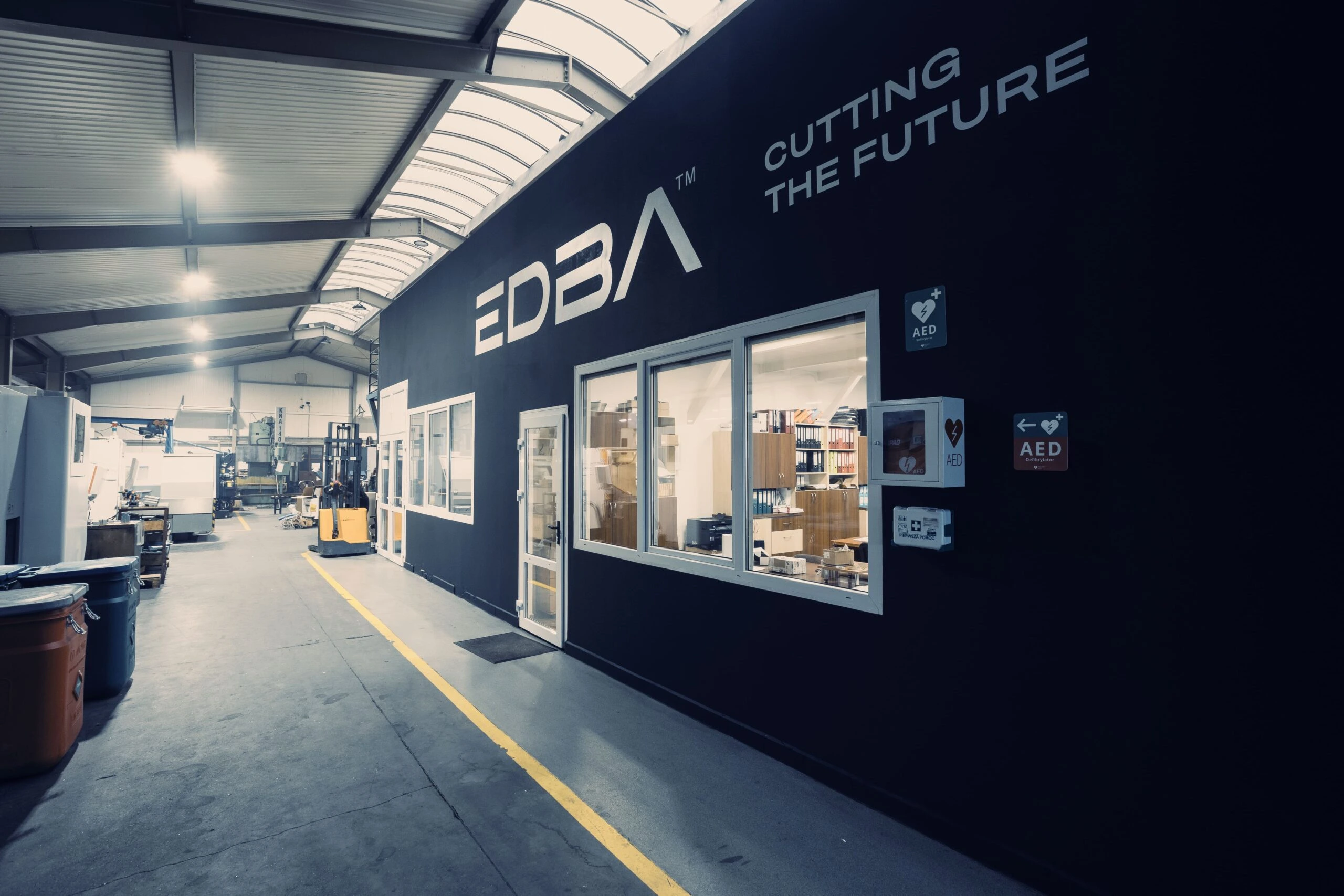
At EDBA, we have turned this philosophy into action. Our production process for the energy sector is the embodiment of preventive quality control. Every project begins with a detailed analysis, while our machining centers are equipped in measuring probe systems that verify critical dimensions after every roughing operation. The data is immediately analyzed and the eventual corrections are applied automatically before the finish cycle begins. The final inspection using a CMM machine is no longer a tool to sieve out deficiencies, but the ultimate verification of a perfectly conducted process.
Trust guaranteed – norms, certifications and a culture of quality
Advanced machines and processes are just part of the equation. Real trust is built on the foundation of standards recognized all around the world and an organizational culture that puts quality at the forefront.
The foundation – ISO 9001
The ISO 9001 norm is an international standard for Quality Management Systems (QMS). It does not define the product quality, but it provides a framework for consistent processes, documentation and constant improvement, guaranteeing a base level of reliability and professionalism.
Industry standards, requirements above and beyond
While ISO 9001 is a universal foundation, the various branches of the energy industry have devised their own, more rigorous standards, due to unique risks and operational conditions.
- Oil & gas industry: the American Petroleum Institute (API) standards are a global reference point. API Spec Q1 is an advanced quality control system that focuses on risk assessment, change management and rigorous control of the supply chain to ensure the equipment’s reality in extremely challenging extraction conditions.
- Wind energy: the IEC 61400 series of norm is key for ensuring the security and reliability of wind turbines. It includes complex requirements regarding designing and testing components (such as blades and gears) as well as assessing the load that a given turbine will be enduring through its entire life cycle.
- Nuclear energy: as an example from the most demanding sector, the ISO 19443 norm expands ISO 9001 with the requirement of promoting a deep safety culture in which safety has an absolute priority over commercial objectives. It also requires full identifiability of the materials and components, as well as rigorous processes preventing the introduction of counterfeit parts.
Quality standards overview in various energy sectors
| Sector | Key Standard | Main Principles |
| General Industry | ISO 9001 | Ensuring consistent processes, documentation management, constant improvements. |
| Oil & Gas | API Spec Q1 | Rigorous market management, control of the supply chain, equipment reliability in difficult conditions. |
| Wind Energy | IEC 61400 | Structural integrity, safety, project verification and testing components through the entire life cycle. |
| Nuclear Energy | ISO 19443 | An overarching safety culture, full identifiability, managing counterfeit, fraudulent and suspect items (CFSI). |
The human element – beyond machines and certifications
Even the most advanced CMM machines and the most rigorous certifications are ineffective without a highly qualified and engaged staff. Quality relies on expert operators, meticulous inspectors and competent engineers who can interpret complex data, make critical decisions and have the authorizations to upkeep the culture of quality.
Certainty engineering
Absolute reliability in the energy sector is not the result of chance. It is the deliberate, designed result of a holistic system that integrates advanced materials, ultra-precise machining, multi-stage inter-operational control, control in real time and a deeply entrenched organizational culture of quality – all of this confirmed by the most rigorous standards in the world.
Quality control is not a cost sink, but a fundamental process of risk management and creating value. It’s a mechanism that transforms uncertainty into certainty.
For projects that have a margin of error of zero, you need more than a supplier – you need a partner in the precision department.
Contact our engineering team and let’s talk how our quality-driven production process can guarantee absolute reliability of your critical components.